

Why businesses can now use AI without giving up control of their data
Every business leader knows AI is changing how companies operate. The tools are there. ChatGPT, Claude, Gemini. They can write reports, analyse data, summarise contracts, answer customer queries, and automate tasks that used to take hours.
So why are so many businesses still not using them?
The answer is simpler than you think. It was never about the technology. It was about trust.
The Real Barrier
No serious business sends its confidential data to an external AI service without asking hard questions first. Where does our data go? Who has access? Is it being used to train the model? Can a foreign government request it?
These are not irrational fears. They are legitimate business risks. When you use a cloud based AI tool, your prompts, your documents, and your company data travel to servers you do not control. For businesses handling sensitive client information, financial data, legal documents, or intellectual property, that is simply not acceptable.
The result? Many businesses either avoid AI entirely or limit it to trivial tasks. They miss out on the competitive advantage because the risk felt too high.
Until now.
The Game Has Changed
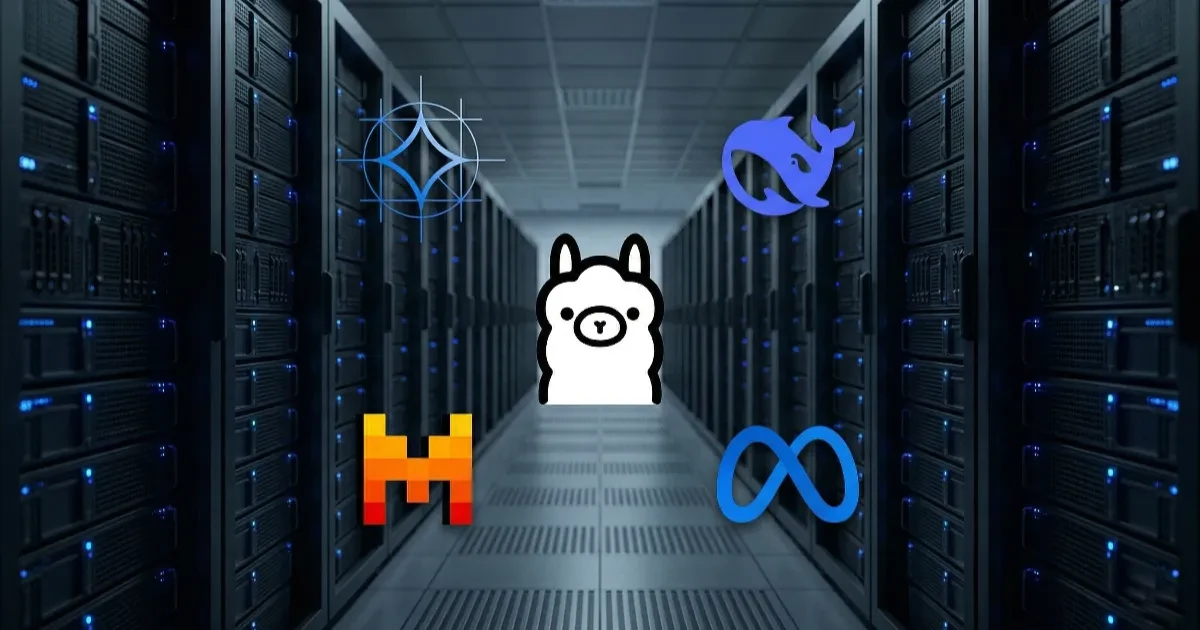
In the last two years, something fundamental shifted. Open source AI models have caught up with their commercial counterparts. Models like Llama, Mistral, Gemma, and DeepSeek now match or exceed the performance of proprietary tools on many real world tasks. Coding, analysis, document processing, multilingual communication. The gap has effectively closed.
But here is what matters most: these models can run on your own infrastructure. Inside your own cloud. Behind your own firewall. Your data never leaves your environment.
That changes everything.
From the Server Room to the AI Brain
If you look at how businesses have managed their IT over the past decades, a clear pattern emerges.
In the 1980s and 1990s, every office had its own server rack. Your data lived on hard drives in the building. Physical access, physical control.
In the 2000s and 2010s, businesses moved to the cloud. Data went to external datacenters run by Google, Amazon, and Microsoft. More flexible, more scalable, but also less visible and less under your control.
Now, we are entering a third phase. The intelligent business cloud. Companies are not just storing data anymore. They are adding an AI brain to their infrastructure. A brain that can analyse reports, draft documents, process data, and support decision making. And the crucial part: it runs inside their own secure environment, on European servers, under their own control.
What This Means for Your Business
Privacy by design. Your data stays on your server. No prompts are sent to external APIs. No documents leave your infrastructure. Full compliance with GDPR and upcoming EU regulations.
Real competitive advantage. While competitors hesitate because of data concerns, you are already using AI to work faster, smarter, and more efficiently. The businesses that adopt this now will be ahead of those that wait.
No vendor dependency. Open source models are not owned by a single company. You can switch models, combine them, or fine tune them for your specific industry. You are not locked into anyone’s ecosystem or pricing.
From storage to action. Your cloud is no longer just a place where files sit. It becomes an active part of your business. A private intelligence that works with your data, for your organisation, and nobody else.
The Opportunity Is Now
The technology barrier is gone. The privacy barrier is gone. Open source AI models are powerful enough for real business use and can run entirely within your own infrastructure.
The only question left is: will you be the business that moves first, or the one that catches up later?
At Innoframe, we build and manage self hosted cloud infrastructure for European businesses. Open source, European hosted, fully under your control. Our architecture is designed to run everything your business needs, including AI, on your own servers without your data ever leaving your environment.
Curious what this looks like for your organisation? Get in touch