
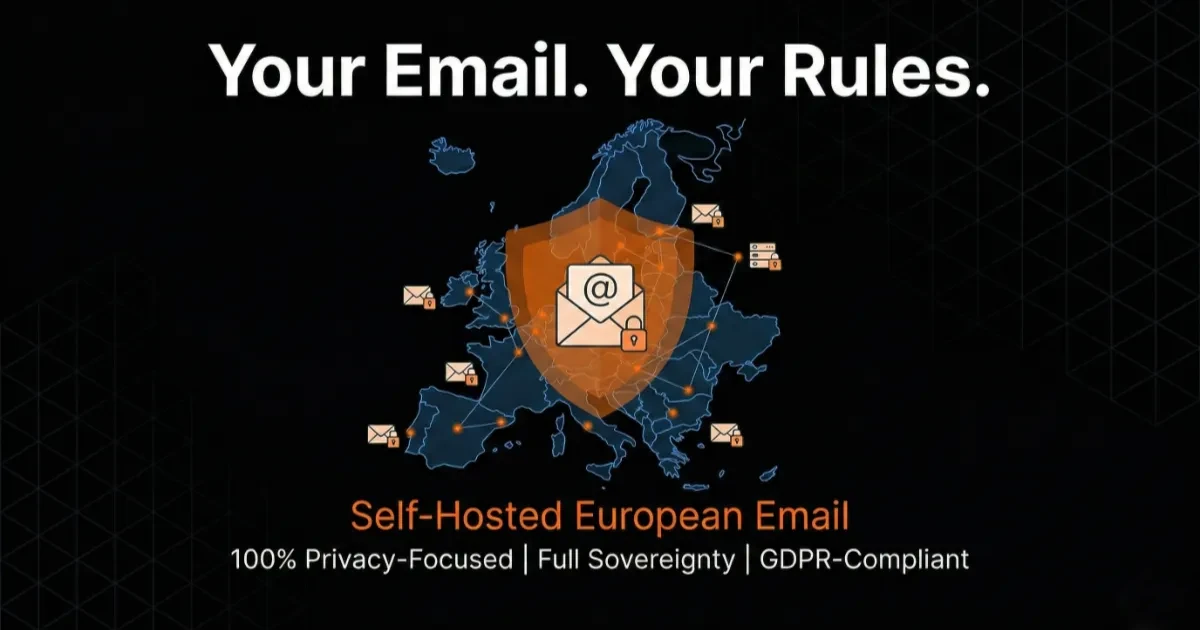

Not so long ago, most companies ran their own email servers, often Microsoft Exchange, on hardware sitting in their own building. Messages were stored locally. There was no third-party scanning content, no data harvested for commercial purposes, and no foreign government with a legal route to your inbox.
The shift to the cloud changed that. Office 365 and Google Workspace offered convenience and in exchange, businesses gradually handed over control of their most sensitive communication to large US providers; providers subject to US law, including the CLOUD Act, which gives American authorities legal access to data stored by US companies regardless of where the servers physically sit.
For a long time, that trade-off felt acceptable. It no longer does. The EU’s push for digital sovereignty, codified in NIS2 and reinforced by recent geopolitical tensions between the US and Europe, has made many European organizations realize they need a different strategy, one where their email infrastructure and the data on it stay under European jurisdiction and under their own control.
The obvious question is: can you actually run your own mail server in 2026?
Yes, but not on your own
Let’s be honest about this. Running a production mail server is one of the hardest things a system administrator can take on. Deliverability is unforgiving. Spam filtering is an arms race. SPF, DKIM, DMARC, DNSSEC, TLS, reputation management, anti-abuse, backup, monitoring; every layer has to be right, and stay right, for years. Even experienced sysadmins routinely underestimate it.
This is precisely why the “just self-host it” advice you see online rarely works out for businesses. The software is open source and freely available. The expertise to run it reliably, at production quality, under European compliance requirements, is not.
That is the gap Innoframe fills. We have been running Linux mail infrastructure since the early 2000s, with Postfix, Dovecot, Rspamd, and ClamAV on Debian, using the same composable, proven open source components we trust for our own systems. No black-box appliances, no proprietary lock-in, no vendor you’ll be stuck with five years from now. You own the server. You own the data. We make sure it runs.
What You Actually Get Back
When your mail server lives on infrastructure you own, in a European datacenter, under European law, several things change at once.
Your communication stays yours. No automated scanning of message content. No metadata mined for advertising. No clauses buried in updated terms of service that quietly authorize your provider to feed your business correspondence into AI training pipelines, something both Microsoft and Google have moved toward in recent years. What you write to your clients, your lawyers, your board, stays between you and them.
Compliance becomes structural, not contractual. GDPR and NIS2 stop being a checklist you negotiate with a US vendor and start being a property of the architecture itself. Data residency is not a setting you toggle; it is where the server physically sits. Retention policies are yours to define. Audit logs are yours to inspect. When a regulator or a client asks where the data lives and who can access it, the answer is short and verifiable.
Your costs stop being a subscription. Per-mailbox pricing made sense when it bundled real operational complexity you could not handle yourself. With a managed self-hosted setup, you pay for infrastructure and expertise, both of which scale far more sensibly than a per-user fee that quietly compounds with each renewal cycle.
You keep optionality. Because the entire stack is open-source and standards-based, nothing in your setup is proprietary to Innoframe. If you ever want to bring it in-house, move to another provider, or change direction entirely, the data, the configuration, and the software all come with you. That is a very different relationship than the one you have with a hyperscaler.
What You Give Up by Staying With Microsoft or Google
It is worth being explicit about the other side of the ledger.
When your business runs on Office 365 or Google Workspace, you are trusting a third party with your most sensitive communication: client discussions, contracts, financial information, internal strategy, HR matters and legal correspondence. All of it lives on infrastructure you do not control, operated by a company headquartered in a jurisdiction that has demonstrated, repeatedly, that it considers itself entitled to that data.
The CLOUD Act is the clearest example. It allows US authorities to compel American companies to hand over data they hold, regardless of where in the world the servers are located. A datacenter in Frankfurt or Dublin offers no protection if the company operating it is based in Redmond or Mountain View. For European businesses and especially for those serving regulated industries, government, healthcare, or legal clients, that is not a theoretical concern. It is a structural conflict with the obligations you already have under European law.
Add to that the recent shift toward using customer data for AI model training, the steady upward drift of per-seat pricing, and the fact that the terms governing all of this can change at any time and the convenience starts looking expensive in ways that do not show up on the invoice.
Is This the Right Move for Your Organization?
Every business should be running its email on its own terms. Not because self-hosting is trendy, but because email carries the commercial weight of the business itself: client correspondence, contracts, financial information, legal matters, internal strategy. Trusting that to a company that reserves the right to scan it, train AI on it, or hand it to a foreign government on request is a choice and it is a choice worth reconsidering.
The alternative is not complicated. It is choosing a smaller European provider you can actually trust, one that does not monetize your data, does not log your messages and operates under the same European legal framework your business already does. That trust is easier to establish with a specialist provider than with a trillion-dollar company whose terms of service change every quarter.
For solo entrepreneurs and small teams, this means a managed mailbox on European-hosted open-source infrastructure, your own domain, your own inbox, your data staying in Europe, without the cost or complexity of running a server yourself. For organizations that need a fully dedicated infrastructure, it means a private mail server under your sole control, with your own IPs and your own data boundary. Same philosophy, different scale.
The mailbox can belong to you again. That is the part worth thinking about.
Innoframe deploys and manages self-hosted email infrastructure for European organizations. Open source, European-hosted, fully under your control, built on the same proven components we have been running for over two decades. Get in touch to discuss what this could look like for your business.